
Mammalian Cell Protein Expression Service
Custom Protein Expression (CPE) provides mammalian cell protein expression services for Non-GMP research and GMP manufacturing. Tailored construct development, transient transfection, expression analysis and project-specific purification support proteins that benefit from mammalian folding, secretion and post-translational processing. Manufacturing controls and quality requirements are selected according to intended use.
Flexible Production Options
Research-scale expression and GMP manufacturing in a GMP-compliant facility.
Target-Specific Cell Expression
Construct, host cell and transfection strategies adapted to secretion, folding and protein stability.
Integrated Quality Support
From gene construction and expression assessment to optional purification, scale-up and documented QC.
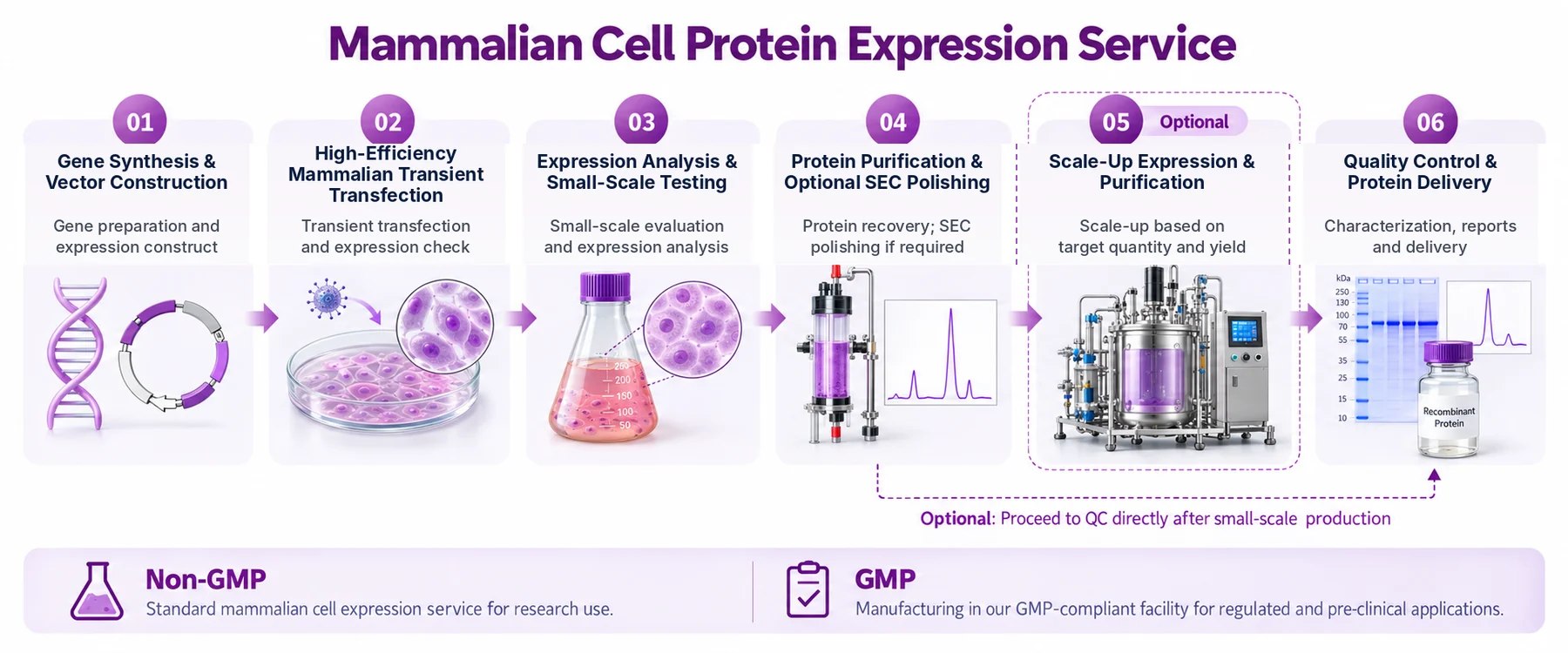
Mammalian Cell Protein Expression Workflow & Stage-Based Pricing
The six stages below are aligned to the available mammalian-cell charging items. Transient transfection and expression analysis make up the standard small-scale test; purification requirements are confirmed separately when requested. GMP projects apply additional facility, process and record controls as defined during technical review.
Pre-project Assessment
Provide the target sequence or accession, desired region and tag, secretion preference, intended use, quantity, purity and functional requirements, manufacturing grade and expected analytical documents. The review defines the transfection, testing and optional purification scope.
Pricing guide
Stage 01 is priced separately at $1.75/aa for both grades. The bold Small-scale Test Fee after Stage 03 is a subtotal, not an additional charge. Stage 04 and Stage 05 are separately scoped; the Standard Package Total appears with Stage 06.
Showing Non-GMP pricingShowing GMP pricing · Standard Package Total (Stages 02–03 + 06): $1,600$2,600
-
Stage 01: Gene Synthesis & Vector Construction
Evaluate the coding region, signal sequence, codon usage and affinity or fusion tag before preparing a mammalian expression construct. Vector design is matched to transient transfection and the required protein form.
Key considerations
Sequence identity; expression regulatory elements; signal peptides; tag placement; correct reading frame; traceability for the GMP route.
Deliverables
Agreed expression construct and supporting sequence/vector information.
Linked service / charging itemNon-GMP (USD)GMP (USD)Gene Synthesis & Vector Construction$1.75/aa -
Stage 02: High-Efficiency Mammalian Transient Transfection
Introduce the construct into a suitable mammalian expression host and carry out the agreed transfection work. Host platform choice and culture format are selected from project requirements rather than assumed for every target.
Key considerations
Transfection conditions; host-cell compatibility; secretion versus intracellular localization; transient expression profile; suitable controls.
Deliverables
Transfected cells or culture material and the relevant experimental records.
Linked service / charging itemNon-GMP (USD)GMP (USD)High-efficiency Mammalian Transient Transfection$800$1,700 -
Stage 03: Expression Analysis & Small-Scale Testing
Evaluate recombinant protein expression in the transient system through an agreed analysis plan. Results help determine whether additional optimization, harvest or downstream purification is worthwhile.
Key considerations
Expression signal; protein integrity; expression yield or estimated titer where measurable; culture conditions; sample stability.
Deliverables
Expression-analysis results and agreed small-scale material or samples.
Small-scale Test Fee is the combined selling price of Stage 02 and Stage 03. It excludes Stage 01, optional SEC/purification add-ons, scale-up and separately quoted special tests.
Linked service / charging itemNon-GMP (USD)GMP (USD)Expression Analysis$480$500Small-scale Test Fee — subtotal of Stages 02–03$1,280$2,200 -
Stage 04: Protein Purification & Optional SEC PolishingOptional
When purified material is required, design a recovery or purification route for the specific protein. Affinity capture, buffer exchange and optional size-exclusion chromatography (SEC) can be scoped according to target properties.
Key considerations
Harvest matrix; affinity-tag or Fc compatibility; yield; aggregation; purity and formulation needs. The underlying quotation does not list a fixed standard purification step outside optional SEC.
Deliverables
Purified protein and available purification results when included in the project quotation.
This stage is optional and does not change the quoted Small-scale Test Fee unless specifically included in the order. Only GMP SEC has a fixed add-on selling price; Non-GMP SEC is quoted by scope.
Linked service / charging itemNon-GMP (USD)GMP (USD)Protein Purification (project-specific)Quotation based on scopeOptional SEC Purification (if needed)Custom quotation$600 -
Stage 05: Scale-Up Expression & PurificationOptional
Following feasibility assessment, larger-scale mammalian culture and purification can be planned when additional protein is needed. Production parameters and controls are transferred to the agreed manufacturing route.
Key considerations
Target yield; medium and feed strategy; harvest timing; consistency of product quality; equipment readiness and GMP batch records.
Deliverables
Agreed scale-up material, purified sample(s) and manufacturing records as contracted.
GMP scale-up requires the agreed process-transfer plan, equipment and facility controls, batch instructions and quality records. Exact yield, quantity and lead time are project-specific.
Linked service / charging itemNon-GMP (USD)GMP (USD)Scale-up Expression & PurificationQuotation based on scale/yield -
Stage 06: Quality Control & Protein Delivery
Select the QC panel, documentation and delivery format to match the intended application. Basic PAGE analysis and a standard COA or study report are priced below; advanced characterization is quoted by assay scope.
Key considerations
Identity and purity; concentration; aggregation, glycosylation or biological activity where relevant; endotoxin and microbial specifications; batch-document expectations.
Deliverables
Final sample(s) and agreed QC results, COA/study report and GMP quality records as applicable.
Standard Package Total includes only the listed small-scale experimental stages and three base QC items. Optional purification/SEC, endotoxin reduction, bioactivity, additional tests, packaging and comprehensive GMP documentation are quoted separately. Endotoxin levels are project-specific targets, not universal guarantees.
Linked service / charging itemNon-GMP (USD)GMP (USD)Native (Non-reducing) PAGE Analysis$80$100Reducing SDS-PAGE Analysis$80$100Standard COA / Study Report$160$200Stage 06 Base QC Subtotal$320$400Standard Package Total (Stages 02–03 + 06)$1,600$2,600Outside the standard packageAdditional Validation TestsCustom quotationOptional Endotoxin RemovalCustom quotation; target <0.1 EU/µg$400; target <0.001 EU/µgBioactivity MeasurementCustom quotation
Routine vs. GMP Protein Production: What Changes?
Both routes can share the core biological expression and purification steps. GMP manufacturing places additional emphasis on controlled facilities, equipment, critical operations, material traceability and evidence of product quality. Specific requirements depend on the intended use and agreed GMP scope.
| Area | Routine / Non-GMP | GMP manufacturing |
|---|---|---|
| Purpose | Research assays, screening and method development. | Defined GMP manufacturing scope and agreed quality expectations. |
| Facility | Fit-for-purpose research cell culture spaces. | Controlled cell culture areas, material flow and contamination prevention. |
| Cleanroom / environment | Laboratory conditions suited to the activity. | Risk-based environmental controls for exposed or sensitive operations. |
| Equipment | Maintained culture and analytical equipment. | Qualification/calibration, maintenance and cleaning records where needed. |
| Cell substrate & inputs | Research host, plasmid and media records as agreed. | Documented source materials, cell history, reagents and traceability. |
| Process controls | Flexible screening of transfection and culture conditions. | Defined critical culture parameters, approved instructions and deviations. |
| Impurities & QC | Fit-for-purpose protein purity and functional tests. | Agreed specifications for identity, impurities, potency and microbiological risks. |
| Documentation | Research results and COA or study report. | Controlled manufacturing/batch records and quality review as scoped. |
GMP Production Requirements: Facility, Cleanrooms and Equipment
Mammalian-cell GMP projects require controls around sensitive cell culture, transfection materials, product recovery and the documented consistency of critical manufacturing operations.

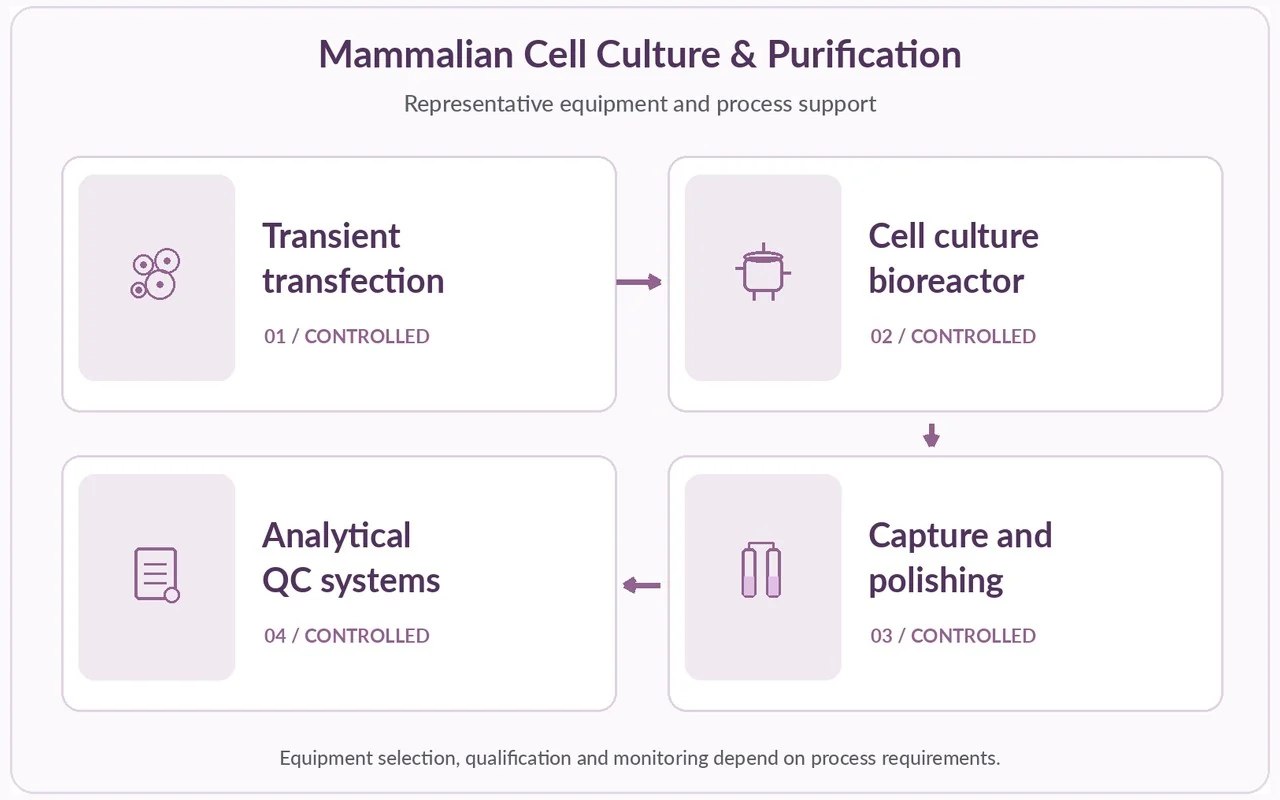
GMP-Compliant Facility & Production Areas
In its GMP-compliant production setting, CPE uses controlled cell culture operations with defined material and personnel flows, cleaning procedures, environmental controls and segregation suited to the process. The production area is assessed for exposure during transfection, culture handling, harvest and product transfer.
Cleanrooms & Environmental Controls
Cell-culture manipulations such as open additions, harvest and post-purification filling are assessed for contamination risk. Cleanroom or other controlled-environment requirements are chosen from the actual operation and intended use; no universal ISO classification applies to all mammalian expression stages. Sterile final product or aseptic fill is separately scoped.
Equipment Qualification, Utilities & Cleaning
Applicable equipment may include controlled cell-culture vessels, monitored incubators, single-use bioreactors, transfer lines, filtration and chromatography systems, and analytical instruments. Qualification, calibration, cleaning, maintenance and status records are applied to critical equipment according to risk and GMP scope.
Raw Materials, Host Systems & Traceability
Documented control of the host cell substrate, plasmid, transfection reagents, culture media and other critical inputs supports traceability. Cell history, identity and qualification expectations are established for the intended product rather than inferred from a routine transient-expression experiment.
Manufacturing Process & Contamination Controls
Important culture attributes can include viable-cell growth, transfection performance, pH, dissolved oxygen (when applicable), culture duration, harvest time and protein recovery. Defined process parameters and documented deviations help maintain consistency as the process moves toward GMP manufacturing.
QC, Documentation & Batch Disposition
Quality review may include identity, purity, concentration, host-cell protein or DNA, aggregation, potency and microbiological or endotoxin controls where justified. A standard COA is not equivalent to a complete GMP batch-release package: records, specifications and additional testing are defined in the quotation.
GMP scope note
GMP-manufactured does not automatically mean sterile, endotoxin-free or suitable for clinical administration. The applicable specifications, testing and quality documentation are confirmed for the intended application.
Optimizing Difficult Mammalian Cell Expression Projects
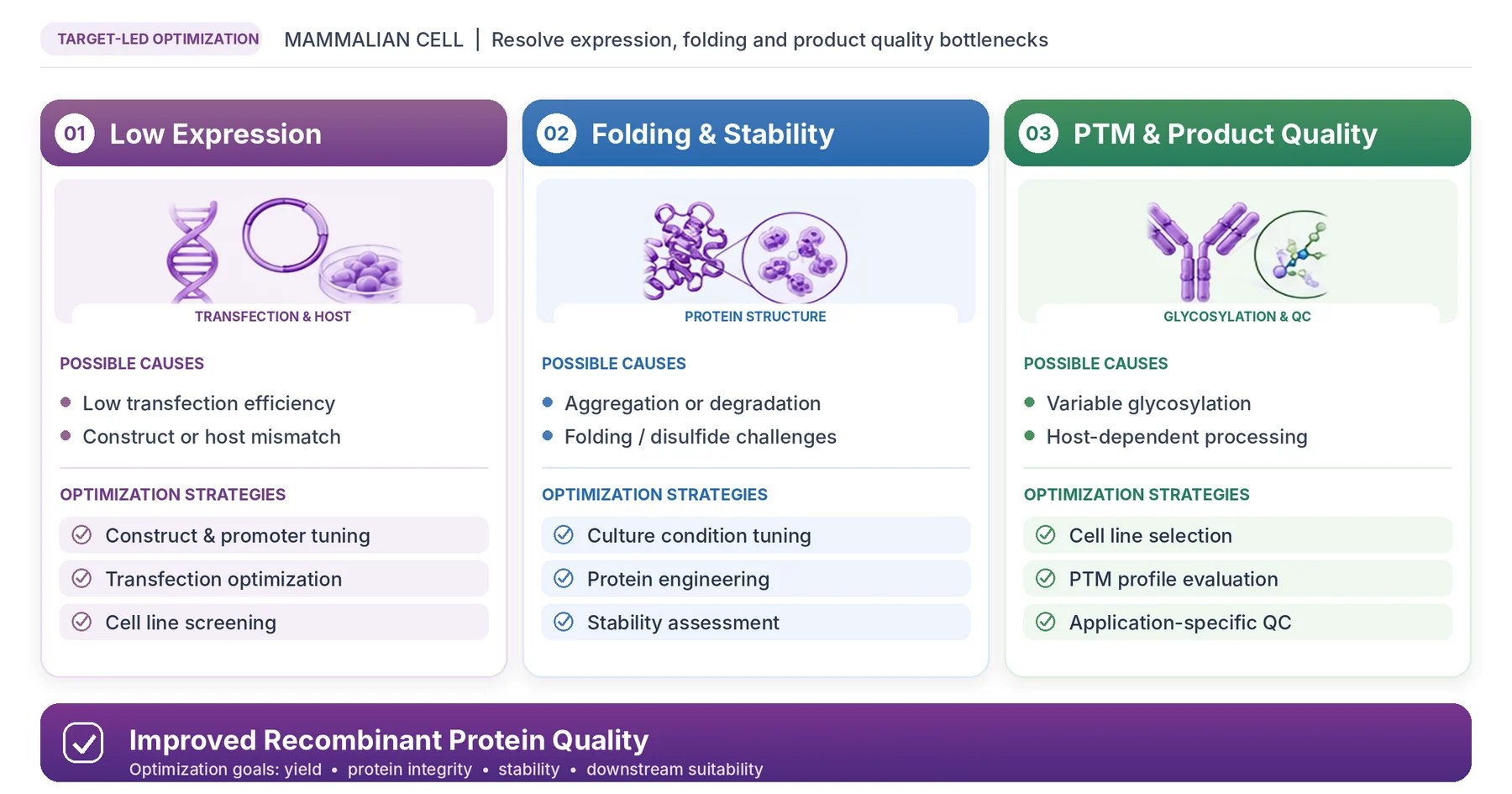
Complex proteins may encounter variable transfection performance, inefficient secretion, aggregation or heterogeneous post-translational processing. A target-specific assessment helps prioritize optimization.
Low Expression or Secretion
Construct/promoter review, host screening and transfection-condition adjustment may improve expression. Targets with inefficient secretion may benefit from signal-peptide or culture strategy review.
Folding and Stability
Complex disulfide-rich or multimeric proteins may require changes to culture conditions, sequence design, formulation and handling. Correct processing and biological activity are assessed separately.
Glycosylation and Product Heterogeneity
Cell line and culture conditions can influence glycosylation and product-related variants. Fit-for-purpose glycan or product-quality characterization can be scoped when required.
Applications
Complex Recombinant Proteins
Growth factors, cytokines, receptors, Fc fusions and other targets that benefit from mammalian processing.
Antibody and Immunology Research
Research antibodies, antibody fragments, antigens and ligands for assay development.
Functional and Biophysical Studies
Protein binding, target validation and structure-function experiments where product quality matters.
GMP-Controlled Protein Supply
Development programs needing controlled mammalian manufacturing and project-specific documentation.
Frequently Asked Questions
What is the difference between Non-GMP and GMP mammalian protein production?
Both routes may use similar expression technologies. GMP programs add defined facility and environmental controls, equipment qualification, material traceability, controlled production records and quality oversight appropriate to the intended application.
Is GMP-grade mammalian protein automatically sterile or endotoxin-free?
No. GMP status does not itself establish sterility or zero endotoxin. Microbial and endotoxin specifications, aseptic processing when required, and corresponding tests are established separately for each project.
What proteins are well suited to mammalian cell expression?
Mammalian expression is frequently selected for secreted, disulfide-rich, glycosylated or complex proteins, including receptors, cytokines and Fc fusions. Suitability depends on the specific sequence and application.
How long does mammalian expression or GMP production take?
Turnaround depends on construct readiness, transfection screening, purification needs, batch size and required quality testing or documentation. A project-specific lead time follows technical review.
Start Your Custom Mammalian Cell Protein Expression Project
Send the target sequence, protein region, construct preferences, required amount, Non-GMP/GMP grade, downstream application and desired QC or documentation. CPE can then confirm the expression route, feasibility and pricing scope.
Contact Custom Protein Expression (CPE) to confirm your target, manufacturing route, timeline and project-specific quotation.