
E. coli Protein Expression Service
Custom Protein Expression (CPE) provides tailored E. coli protein expression services for both Non-GMP research and GMP manufacturing. Our services cover gene construction, expression optimization, protein purification, and quality control, with GMP production supported by our GMP-compliant facility. E. coli is an established, scalable host for proteins that do not require complex eukaryotic post-translational modifications.
Flexible Production Options
Non-GMP research production and GMP manufacturing supported by our GMP-compliant facility.
Customized Expression Strategies
Protein-specific construct design, expression optimization, and purification strategies tailored to project requirements.
Integrated Services & Quality Control
From gene synthesis and small-scale production to optional scale-up, QC testing, and protein delivery.
E. coli Protein Expression Workflow & Stage-Based Pricing
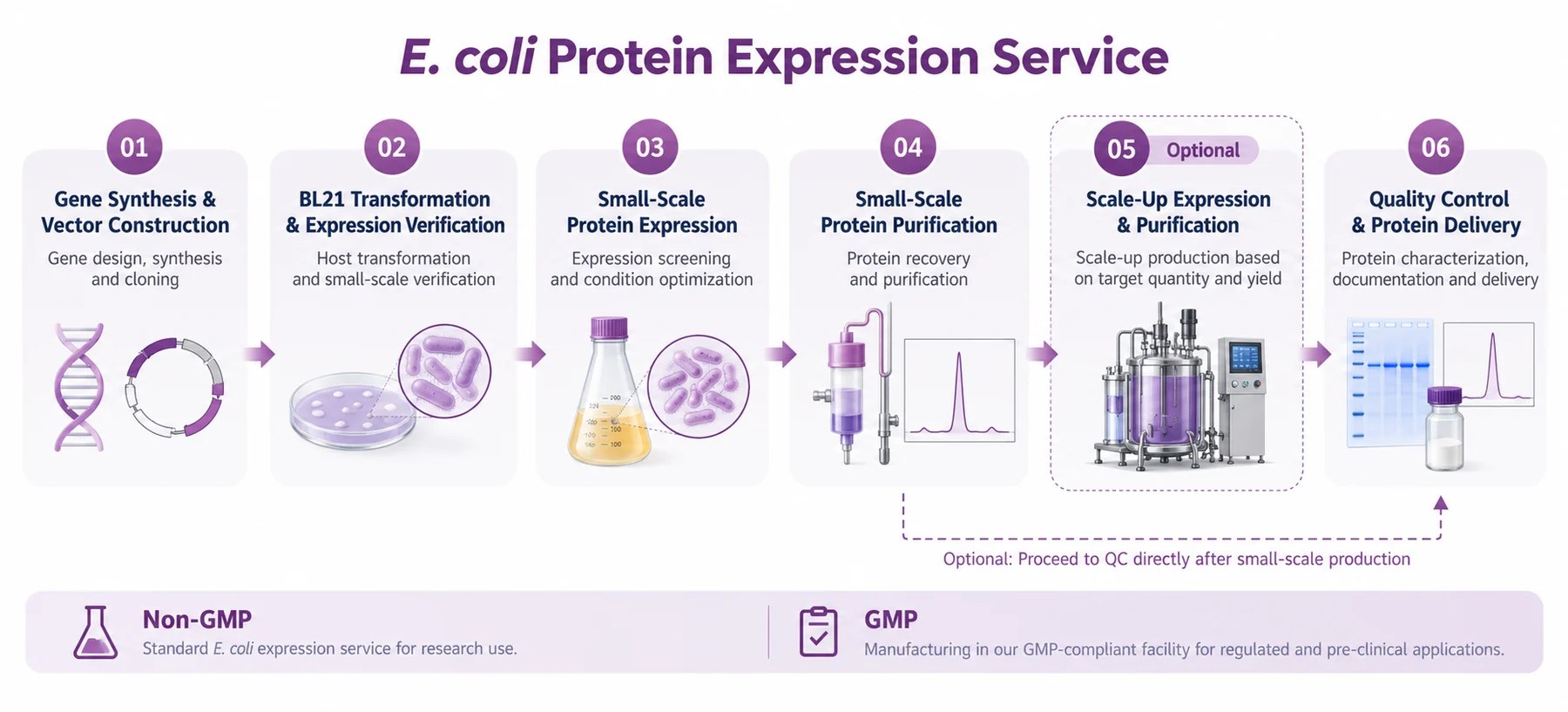
The service is organized into six practical stages that follow the production and quotation items. The same broad technical sequence supports routine (Non-GMP) and GMP projects, while controls, records, equipment and quality requirements are selected for the manufacturing route and intended application.
Pre-project Assessment (before the six laboratory stages)
We review the protein sequence or accession, expression region, preferred tag, intended use, target amount, purity, endotoxin limits, formulation and requested manufacturing grade. This discussion establishes the feasibility and quotation scope and is not shown as a separately priced experimental stage.
Pricing guide
Gene synthesis and vector construction (Stage 01) is $1.75/aa for both routes. The Standard Package Fee covers Stages 02-04 and the three basic QC items in Stage 06: $800 (Non-GMP) or $1,800 (GMP). The bold stage subtotals are included, not additional charges. Stage 05 and optional services are quoted separately.
Showing Non-GMP pricingShowing GMP pricing · Standard Package Fee (Stages 02–04 + 06): $800$1,800
-
Stage 01: Gene Synthesis & Vector Construction
Review the selected protein region and design or prepare the expression construct, including coding sequence, vector elements and the agreed fusion or purification tag. Gene synthesis and cloning are planned around E. coli expression and downstream use.
Key considerations
Sequence correctness, construct design, protein domain boundaries, tag placement, purification compatibility and, where applicable, controlled starting-material records.
Deliverables
Recombinant expression vector and agreed construct/sequence documentation.
Linked service / charging itemNon-GMP (USD)GMP (USD)Gene Synthesis & Vector Construction$1.75/aa -
Stage 02: BL21 Transformation & Expression Verification
Introduce the recombinant plasmid into E. coli BL21 and conduct initial expression verification to assess whether the target protein can be detected before the small-scale production run.
Key considerations
Construct-host compatibility, recombinant expression level, preliminary solubility observations where appropriate, and suitability of the transformed strain for the agreed route.
Deliverables
Expression verification results and a selected working expression strain or clone, as applicable.
Linked service / charging itemNon-GMP (USD)GMP (USD)BL21 Transformation & Expression Verification$160$200 -
Stage 03: Small-Scale Protein Expression
Produce recombinant protein at small scale and assess expression conditions based on the target. Routine production uses fit-for-purpose small-scale cultivation; the listed GMP small-scale offering uses a 2 L animal-component-free bioreactor.
Key considerations
Induction strategy, temperature, expression duration, soluble protein recovery, culture conditions and defined process parameters for the selected manufacturing route.
Deliverables
Small-scale expression batch or harvested material for purification, with agreed expression data.
Linked service / charging itemNon-GMP (USD)GMP (USD)Small-scale Protein Expression / 2 L Bioreactor Production$320$600 -
Stage 04: Small-Scale Protein Purification
Recover the expressed protein and perform purification using a suitable approach. For the listed GMP small-scale offering, the defined base step is IMAC purification of the 2 L expression batch. Optional SEC polishing may be selected when needed.
Key considerations
Soluble versus insoluble recovery, affinity-tag compatibility, preliminary purity and yield, buffer formulation and the need for additional polishing or refolding.
Deliverables
Purified small-scale recombinant protein sample and available purification or recovery data.
The bold Small-scale Test Fee ($640 Non-GMP / $1,400 GMP) covers Stages 02-04 only. It is already included in the Standard Package Fee on Stage 06; it excludes gene synthesis, scale-up, optional SEC polishing and other additional services.
Linked service / charging itemNon-GMP (USD)GMP (USD)Small-scale Protein Purification / IMAC Purification$160$600Small-scale Test Fee — total for Stages 02–04$640$1,400Optional SEC Purification (if needed)Quotation upon request$600 -
Stage 05: Scale-Up Expression & PurificationOptional
Where more material is required, move from the agreed small-scale outcome to an appropriate scale-up expression and downstream purification process. Scale-up is optional; projects requiring only the small-scale purified sample may proceed directly to Stage 06.
Key considerations
Target quantity and yield, fermentation capacity, process transfer, reproducibility, purification recovery and grade-appropriate manufacturing controls and records.
Deliverables
Scale-up production material, purified protein and agreed manufacturing or batch documentation.
For GMP scale-up, the applicable facility controls, equipment readiness, approved instructions and manufacturing records are agreed before the production batch. Scale-up conditions are not automatically identical to screening conditions.
Linked service / charging itemNon-GMP (USD)GMP (USD)Scale-up Expression & PurificationQuotation based on scale/yield -
Stage 06: Quality Control & Protein Delivery
Characterize and prepare the purified protein according to its intended application and agreed specifications. Select analytical tests, endotoxin control, formulation and delivery format in advance; GMP documentation and release requirements are defined by the project.
Key considerations
Identity and purity, concentration, PAGE conditions, endotoxin specifications, required bioactivity, stability, sample format and documentation scope.
Deliverables
Protein sample(s), available analytical data and the agreed COA, study report or GMP-related quality records.
Standard packages include small-scale expression, purification and basic QC. Optional SEC purification, additional analytical tests, lyophilization, endotoxin removal and bioactivity measurement are outside the standard package unless specified in the quotation. Endotoxin limits are service targets, not unconditional guarantees; scope and final specifications are confirmed before production.
Linked service / charging itemNon-GMP (USD)GMP (USD)Native (Non-reducing) PAGE Analysis$40$100Reducing SDS-PAGE Analysis$40$100Standard COA / Study Report$80$200Basic QC Fee — total for Stage 06 standard tests$160$400Standard Package Fee — total for Stages 02–04 + 06$800$1,800Outside the standard packageAdditional Validation TestsQuoted by test scopeLyophilization ServiceQuotation based on format/vial countUp to 2 test vials included; extras $40 each or $1,000 for up to 50 vialsOptional Endotoxin RemovalQuotation upon request; target <0.1 EU/µg$400; target <0.001 EU/µgBioactivity MeasurementQuoted by assay scope
Routine vs. GMP Protein Production: What Changes?
A GMP program typically requires greater control and documented evidence at each relevant stage, rather than a completely different biochemical expression mechanism. The comparison below summarizes common distinctions; specific requirements depend on product type, manufacturing stage and regulatory jurisdiction.
| Area | Routine / Non-GMP | GMP manufacturing |
|---|---|---|
| Intended use | Laboratory research, assay development and other agreed non-clinical applications. | Defined GMP programs with specified material purpose, manufacturing scope and release expectations. |
| Facility | Appropriate research laboratories and production areas with fit-for-purpose controls. | GMP-compliant facility with controlled production zones, defined flows and contamination-control procedures. |
| Cleanroom / environment | Standard laboratory controls; classified areas only where justified by the operation. | Cleanroom or other controlled environments selected through risk assessment for open, closed and product-exposed operations; suitable monitoring and cleaning. |
| Equipment and utilities | Maintained and calibrated as needed for reliable experimental work. | Equipment qualified for intended use, calibrated and maintained under records; utilities and cleaning controlled as required. |
| Materials and host strain | Research-grade materials and strain records appropriate to the study. | Defined material specifications, traceability, supplier controls and suitable cell-bank/strain documentation. |
| Process control | Flexible screening and optimization; project-specific records. | Approved instructions, defined critical parameters, in-process controls and documented deviations or changes. |
| Purification / impurities | Purification designed for required yield, purity and function. | Defined process and impurity-control strategy, including host-cell components and endotoxin where relevant. |
| QC and release | Fit-for-purpose purity, concentration and requested analytical tests. | Agreed specifications, appropriate validated/qualified methods, batch records, QC review and documented disposition. |
| Documentation | Data summary, research report and COA as agreed. | Controlled records and a project-specific GMP documentation package appropriate to the regulatory context. |
GMP Production Requirements: Facility, Cleanrooms and Equipment
GMP production places additional emphasis on preventing contamination and demonstrating that each critical manufacturing activity was carried out under appropriate, recorded conditions. The following controls are especially relevant to recombinant proteins expressed by microbial fermentation.
GMP-Compliant Facility and Manufacturing Areas
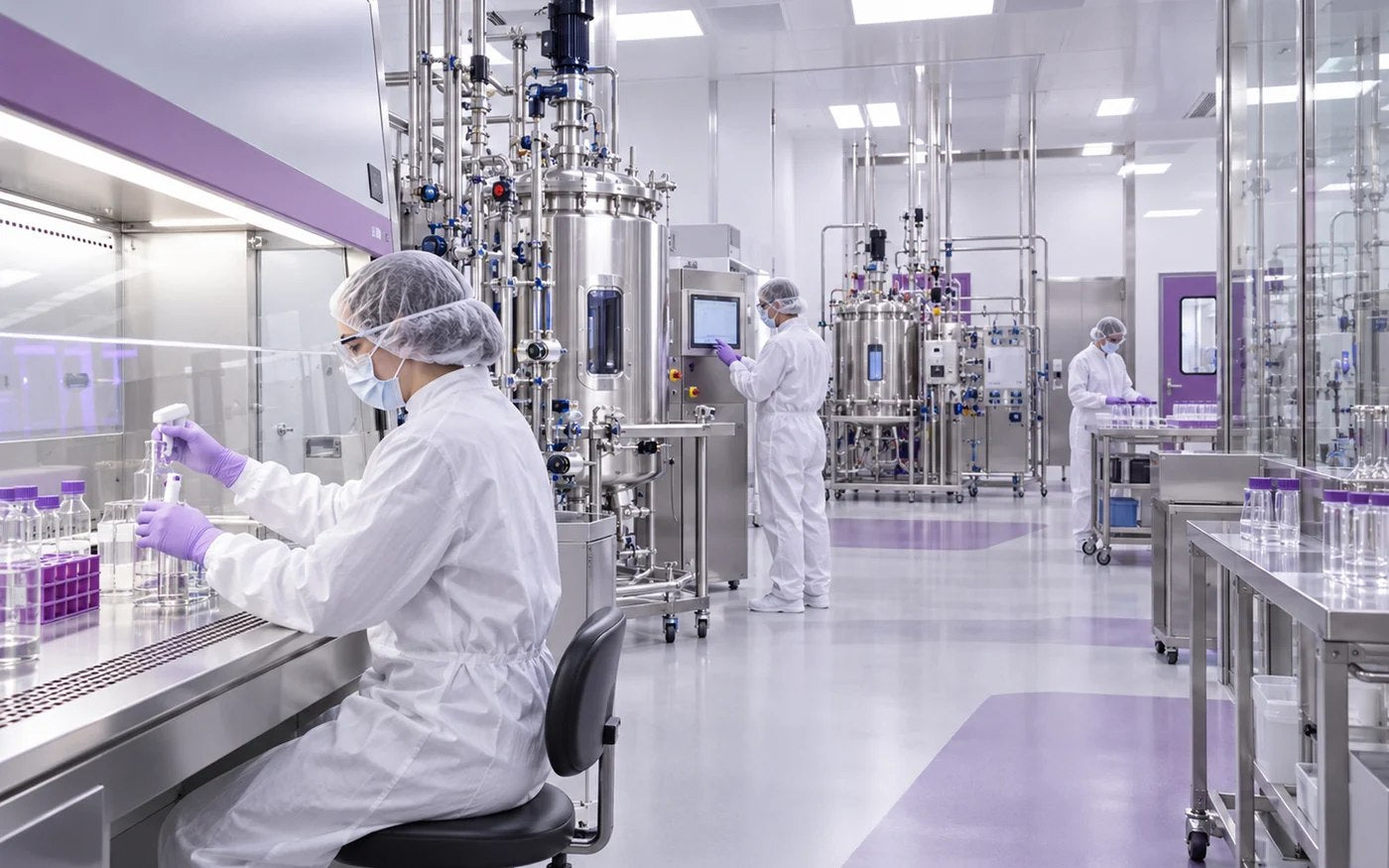
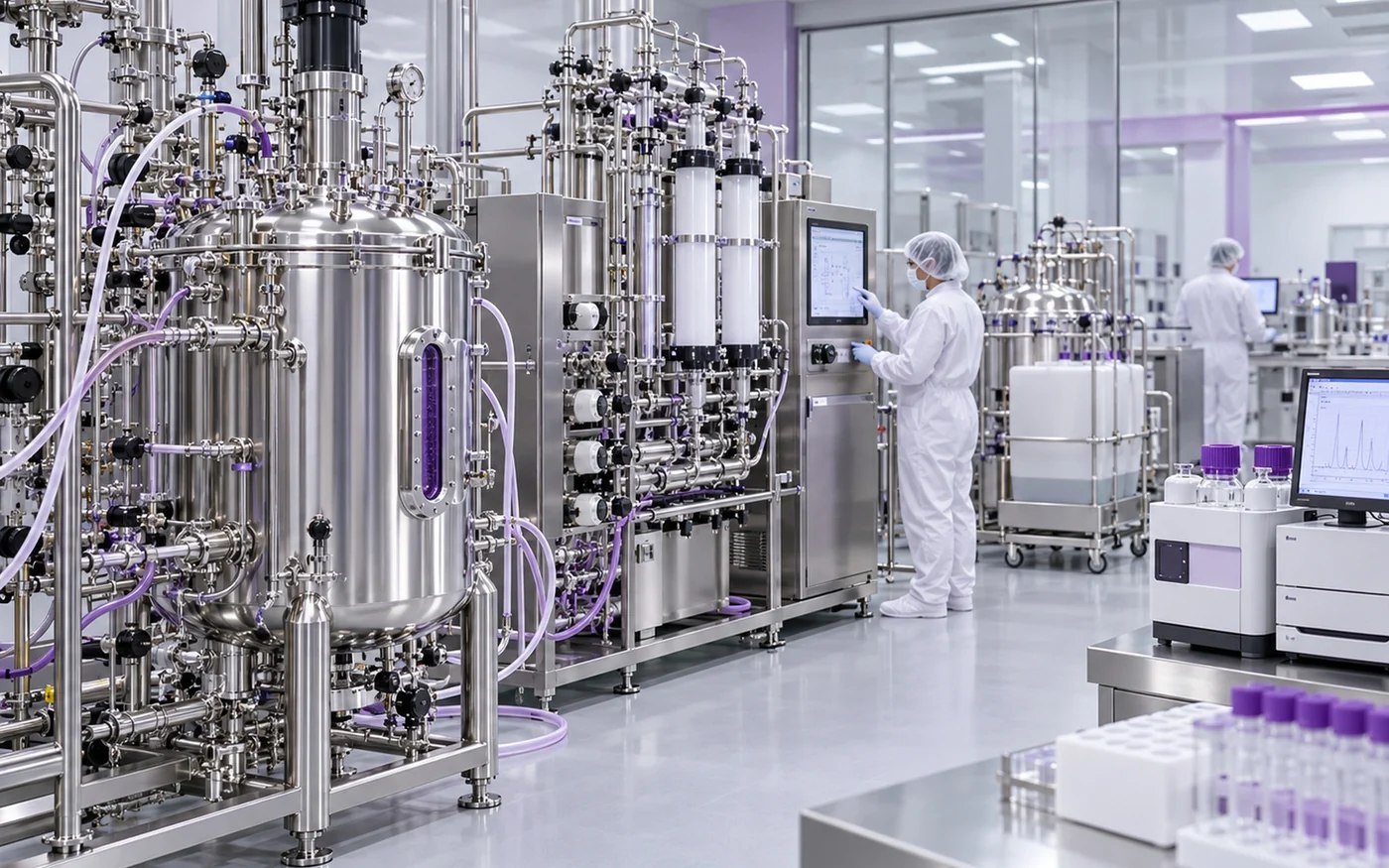
CPE uses its own GMP-compliant facility for GMP protein production. A GMP facility is more than a laboratory designated for high-purity work: its design and operating procedures must support controlled material and personnel movement, appropriate segregation of processing activities, cleaning and sanitation, equipment placement and the prevention of mix-ups and cross-contamination. Closed or contained systems can reduce exposure during fermentation and transfer operations.
Cleanroom and Controlled-Environment Requirements
Cleanroom requirements are established from the process risk and the stage of manufacture. Open manipulations, transfers, post-purification handling or filling may need tighter environmental controls than well-contained fermentation processes. Where relevant, controlled areas incorporate suitable air handling or filtration, pressure relationships, gowning procedures, cleaning and environmental monitoring. The specific room classification and monitoring limits are selected for the operation; a single ISO class or EU Grade A/B/C/D cannot responsibly be assigned to every GMP E. coli production step.
If sterile final material or aseptic processing is required, the scope is assessed separately and additional sterile-manufacturing requirements may apply. GMP-grade and sterile are not interchangeable descriptions.
Qualified Equipment, Utilities and Cleaning
GMP production requires documented control over critical equipment such as bioreactors, temperature and pH sensors, mixing and aeration systems, centrifuges, homogenizers, chromatography systems and monitoring instruments. Depending on use and risk, qualification, calibration, preventive maintenance, cleaning verification or validation, and controlled utility systems help establish that equipment performs within its defined operating range. Equipment status and usage are documented as applicable.
Controlled Raw Materials, Strains and Cell Banks
GMP processes place greater emphasis on defined specifications and traceability for expression strains, plasmids, media components, buffers and other critical inputs. Appropriate cell substrate identification, banking or seed controls, storage conditions and records help support manufacturing consistency. Animal component-free materials may be selected for programs that require them; the quotation includes an animal component-free 2 L bioreactor production option for GMP projects.
Process Monitoring and Contamination / Endotoxin Control
For microbial fermentation, critical variables may include temperature, pH, dissolved oxygen, agitation, gas addition and induction conditions. Defined in-process checks, cleaning controls and segregation limit the risk of contamination. Because E. coli is a Gram-negative bacterium, endotoxin management can be important, particularly for material intended for cell-based or regulated downstream processes. Endotoxin removal, testing, acceptance limits and feasibility are established for each project; low endotoxin is not automatically equivalent to GMP status.
Quality Oversight, Batch Documentation and Release
A GMP project is supported by a planned documentation and quality-control strategy, which may include approved procedures, material records, equipment logs, batch production records, analytical results, deviations, change management and appropriate quality review. Release tests are selected according to intended use and may include identity, purity, protein concentration, endotoxin and biological activity. Additional tests, method qualification or validation, process validation and stability studies are scoped individually rather than assumed for every quotation.
Optimizing Difficult E. coli Expression Projects
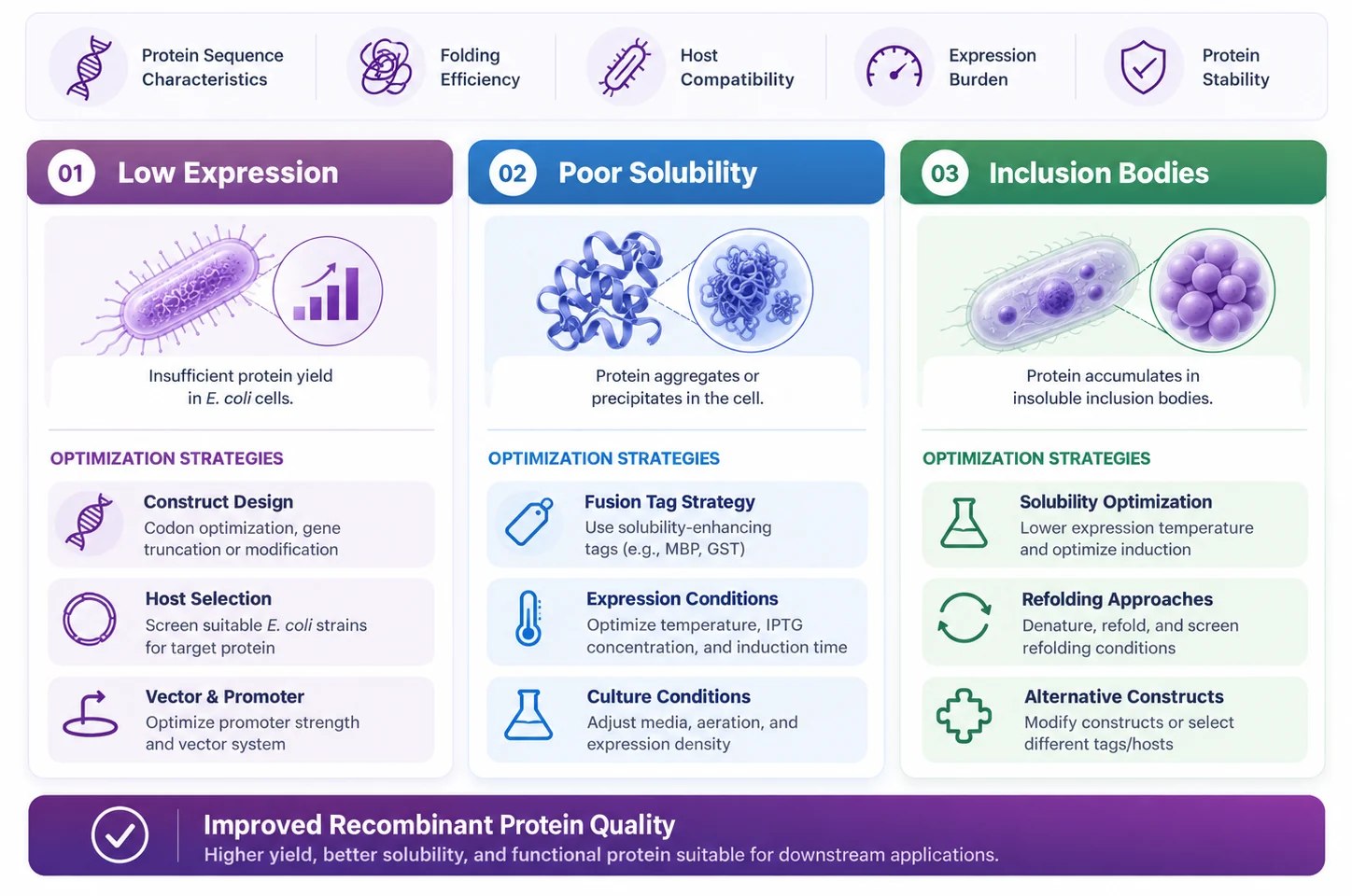
Some targets show low expression, poor solubility or accumulation in inclusion bodies. A customized strategy can improve expression performance, protein recovery and compatibility with downstream analysis; outcomes depend on the individual sequence and protein properties.
Low Expression
When expression is limited by sequence features, construct design or host compatibility, options include construct redesign, evaluation of alternative hosts, vector or promoter changes, and adjustment of expression conditions.
Poor Solubility
High total expression does not always produce soluble functional protein. Appropriate optimization may involve fusion tags, lower induction temperature, modified induction conditions, culture adjustment or alternative expression constructs.
Inclusion Body Formation
Proteins recovered in inclusion bodies may require adjustments to expression conditions, different constructs or a carefully evaluated solubilization and refolding strategy. Recovery and activity after refolding are assessed on a project-specific basis.
Applications of E. coli-Expressed Recombinant Proteins
Biochemical and Functional Research
Protein samples may be used in enzyme activity studies, protein interaction analysis, target characterization and biochemical method development.
Assay Development and Structural Biology
Purified recombinant proteins can support binding assays, screening assay development, structural studies and biophysical characterization, subject to agreed purity, stability and formulation requirements.
Antibody and Immunology Research
E. coli-produced antigens and protein domains may be suitable for antibody generation, immunoassay development and target validation when the required epitope structure can be reproduced.
GMP-Controlled Manufacturing Programs
Projects requiring controlled production, traceable raw materials, specified endotoxin limits or regulated downstream manufacturing may benefit from the GMP route. Suitability as an ancillary material, process reagent or other application-specific input must be confirmed against the customer's quality and regulatory requirements.
Frequently Asked Questions
What is the difference between Non-GMP and GMP E. coli protein production?
The major differences are the intended use and level of manufacturing oversight. GMP work adds controlled facilities and environmental measures, equipment qualification, materials traceability, documented processes, quality review and defined release expectations; the basic expression and purification technologies may be similar.
Is GMP-grade E. coli protein automatically sterile or endotoxin-free?
No. Sterility and endotoxin content are separate product attributes, specified and tested for the intended application. E. coli-derived proteins may require dedicated endotoxin reduction and testing. Regulatory suitability is assessed case by case.
What proteins can be made using E. coli?
Many soluble enzymes, bacterial or non-glycosylated proteins, domains and research antigens can be expressed. Proteins requiring complex mammalian post-translational modifications, difficult folding or particular biological activity may need further engineering or another host system.
How long does an expression or GMP production project take?
Timing depends on the starting materials, construct readiness, screening needs, scale, purification strategy, required testing and the scope of GMP controls. A project-specific lead time is confirmed following technical review.
Start Your Custom E. coli Protein Expression Project
Whether you need a research-ready recombinant protein or a defined GMP manufacturing route, CPE can review your sequence, production volume, purification strategy and analytical requirements to develop a project-specific plan.
Contact Custom Protein Expression (CPE) to request a technical assessment and quotation for routine or GMP E. coli protein expression.